{{ current + 1 }}/{{ total }}

1917 – Red Guards

Sometimes the term ‘Red Guards’ is used in a broad sense to mean any armed groups that supported the Bolsheviks. To a large extent this is because after the October Revolution the term ‘Red Guards’ was used to indicate volunteer paramilitary formations set up by the Bolsheviks and fighting on the side of the Soviet authorities during the first months of the Civil War.

From February to October 1917, ‘Red Guards’ was what people called militant units established by the Bolsheviks at large factories and plants and managed by local Bolshevik organizations. The Bolshevik party made the decision to set up the Red Guards soon after the February Revolution, before Lenin’s return to Russia. Initially it was perceived as reviving the combat unit of the Russian Social Democratic Workers' Party, active during the 1905 Revolution and disbanded thereafter. The Russian word ‘boyevik’ (militant) originally referred specifically to members of the combat Bolshevik units.
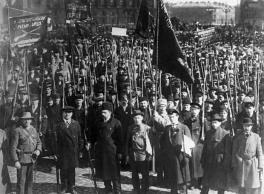
Red Guard units during May Day demonstration. 1917. Sputnik
{{ current + 1 }}/{{ total }}

According to some guardsmen, at first the weapons for the new units in Moscow came in part from the arms depots that the labor organizations managed to preserve and maintain since the 1905 Revolution. Admittedly, the events of 1917 provided many other options for arming combatants.

It was decided that the newly created militant units would be called ‘guards,’ though for some time both ‘Red’ and ‘Labor’ were used as part of the name. In the first months after the February Revolution the Bolsheviks didn’t have significant influence over the army, so it was considered important to set up units comprised of workers who would be under the direct command of party officials.

Initially, guardsmen were responsible for patrolling rallies and dispersing street rallies organized by political opponents. The Red Guards were not completely legal, so they had to operate in secrecy (especially, after the July demonstration in Petrograd supported by the Bolsheviks ended in disaster).

{{ current + 1 }}/{{ total }}

The Red Guards’ status changed drastically after Lavr Kornilov’s failed coup. The Bolshevik workers’ units supported the Provisional Government and played their part in the defense of Petrograd. This forced the authorities to legalize the units. When the coup began, the Provisional Government equipped the Red Guards with firearms. Previously, party organizations had to solve the problem of acquiring new weapons on their own, but it wasn’t an easy task even in a situation of anarchy, so the units were ill-equipped. The units were supposed to turn in their firearms after the Kornilov coup was suppressed. In reality this never actually happened.

After the Red Guards were legalized, they were supposed to come under the control of political organizations and stop being purely Bolshevik. But the Bolsheviks managed to preserve their almost complete control over their guards, thus turning the regulatory bodies into powerless structures.

{{ current + 1 }}/{{ total }}

The Red Guards in Moscow and Petrograd took orders from their headquarters which supervised the guardsmen’s operations during the armed uprising in the two cities, but of course in both cities these headquarters were controlled by military revolutionary committees which were leading the uprising.